

Quick Summary
The strolling technique is a bass presentation where you slowly move a bait along a line, pausing and twitching it to keep it in the strike zone longer. Paired with forward facing sonar, it lets you spot suspended bass ahead of the boat and position your bait in front of them.
- Forward facing sonar projects a beam ahead of the boat, showing fish and structure in front of you.
- Idle slowly while scanning, since speed shortens the time the beam spends on each target.
- Mark a school and approach from the side so your bait passes through the zone without crossing directly over the fish.
- Confirm your lure is visible on screen at the depth you expect before blaming the fish for missed bites.
- Slow the boat before the first cast, because motoring too fast can push marked bass out of range.
Table of Contents
- What Strolling Means and Where It Fits With Forward Facing Sonar
- How Strolling Differs From Hover Strolling and Vertical Fishing
- Using Forward Facing Sonar to Locate Suspended Bass
- Reading Fish Position and Behavior on the Screen
- Mid-Strolling for Bass: Matching Depth, Cadence and Cover
- Best Lures for Mid-Strolling With Forward Facing Sonar
- Mid-Strolling Rod and Reel Setup, Line and Jig Heads
- A Repeatable Sonar-to-Cast Workflow on the Water
- Troubleshooting Missed Bites and Unproductive Follows
- Adjusting Your Strolling for Season, Weather and Water Clarity
- Frequently Asked Questions
What Strolling Means and Where It Fits With Forward Facing Sonar
Last Updated: October 28, 2026
The strolling technique is a bass presentation where you move a bait slowly along a line, pausing and twitching it so it stays in the strike zone longer. Paired with forward facing sonar (FFS), it lets you see suspended fish ahead of the boat and then position a bait precisely in front of them. At Kaizen Fishing USA, the tackle selection includes finesse soft plastics and compact crankbaits.
Forward facing sonar is the important part of the equation. Unlike traditional down-imaging, which shows what is directly beneath the transducer, FFS projects a beam ahead of the boat and shows fish and structure in front of you. That changes the approach: instead of waiting for a fish to swim under you, you can locate bass and move to them.
The strolling technique sits in the middle of this workflow. Once the sonar shows a group of suspended bass, the angler slows the boat, establishes a line, and works a bait through the zone where the fish are holding. The technique depends on the bait staying in the window the fish are willing to strike in, which is why depth control and retrieve cadence matter so much.
Many anglers assume strolling is only for deep, open water. In practice, it works along points, ledges, and submerged cover wherever suspended bass set up. The key is recognizing when the fish you see on the screen are actually feeding and not just passing through.
Watch out: Motoring too fast over a school you have marked on FFS can push the bass out of range before your bait gets there. Slow the boat down before you make the first cast.
How Strolling Differs From Hover Strolling and Vertical Fishing
Strolling, hover strolling, and vertical fishing all target suspended fish, but they differ in how the boat and the bait move. Knowing which one you are doing determines your rod, your lure choice, and how you read the sonar.
Hover strolling keeps the boat holding position over fish while the angler casts and works baits in a tight area. The boat is essentially stationary, and the sonar is used to keep the bait in the zone above the school. It suits fish that are stacked tightly and do not travel far.
Vertical fishing, such as Damiki-style presentations, drops a bait straight down to fish stacked under the boat. The line stays close to vertical, and the angler works the bait with small jigging motions. It is effective when fish hold directly beneath the boat but limits how much water you cover.
Strolling is the most mobile of the three. The boat moves at a controlled speed, the bait is cast ahead and retrieved across the fish's path, and the angler uses pauses to hold the bait at depth. That horizontal movement is what lets you cover a broader area and react to fish you spot on the screen.
Choosing among them comes down to how the fish are positioned. If the bass are tight to a spot, hover strolling or vertical work may keep you in the zone longer. If they are spread along a point or ledge, strolling covers ground faster and gives you more chances to contact fish.
Using Forward Facing Sonar to Locate Suspended Bass
Forward facing sonar works best when you use it deliberately rather than just watching the screen as you run. Start by setting the beam angle and range so you can see the water column ahead of the boat, typically the zone from the surface to the bottom where suspended bass tend to hold.
Idle slowly while scanning. Speed reduces the time the beam spends on each target and makes it harder to separate fish from background clutter.
Look for consistent arcs or clusters that hold their shape as you move. Scattered single returns can be baitfish, debris, or noise. A group that stays put in the same depth band across several passes is more likely to be a target worth working.
Once you find fish, mark the spot and note the depth. Then plan a line that lets your bait pass through the zone without crossing directly over the school. Approaching from the side keeps you from spooking the fish and gives you a cleaner presentation.
Reading Fish Position and Behavior on the Screen
Fish position tells you how far to drop or raise the bait, fish behavior tells you how to present it, and your settings determine whether you can trust either read. Treat the screen as an instrument you calibrate, not a television you watch.
Set the screen before you read it. Start with a range that covers the water column you intend to fish plus a little margin, commonly 60 to 80 feet forward, so you can see a target and still have room to plan a cast. Use a forward range that matches your typical cast distance; if you routinely cast 80 feet, a 40-foot range hides the fish you can actually reach. Set gain/sensitivity just high enough that your lure shows as a clear, consistent mark without the water column filling with speckle. If the screen looks like static, back the gain down until only solid returns remain. Use zoom on the depth band where fish are holding rather than zooming the whole column; a tight zoom on a 10-foot band makes a suspended school and your bait easy to compare side by side.
Separate the lure from the fish. The single most useful skill is tracking your own bait. A jig head or crankbait returns a compact, bright mark that moves on a predictable line as you retrieve. Bass returns are larger, often softer-edged, and hold position or move independently of your bait. Baitfish show as diffuse clouds or tight balls of small returns. When your lure mark and a fish mark converge and the fish mark changes direction toward the lure, that is a follow, and the moment to change cadence. If you cannot find your lure on screen, you cannot diagnose a missed bite, so confirm the lure is visible before you judge fish behavior.
Read position first. Note where returns sit relative to structure, a school hanging a few feet above a ledge is positioned to ambush, so run the bait at that offset rather than dragging it through the cover itself.
Read baitfish context.
Keep settings consistent within a session. Small gain or sensitivity changes can make a school appear to shrink or grow, which leads to bad depth decisions. Change one setting at a time, and note in your log the range, gain, and zoom you used when a pattern produced bites so you can recreate the read on the next trip.
Mid-Strolling for Bass: Matching Depth, Cadence and Cover
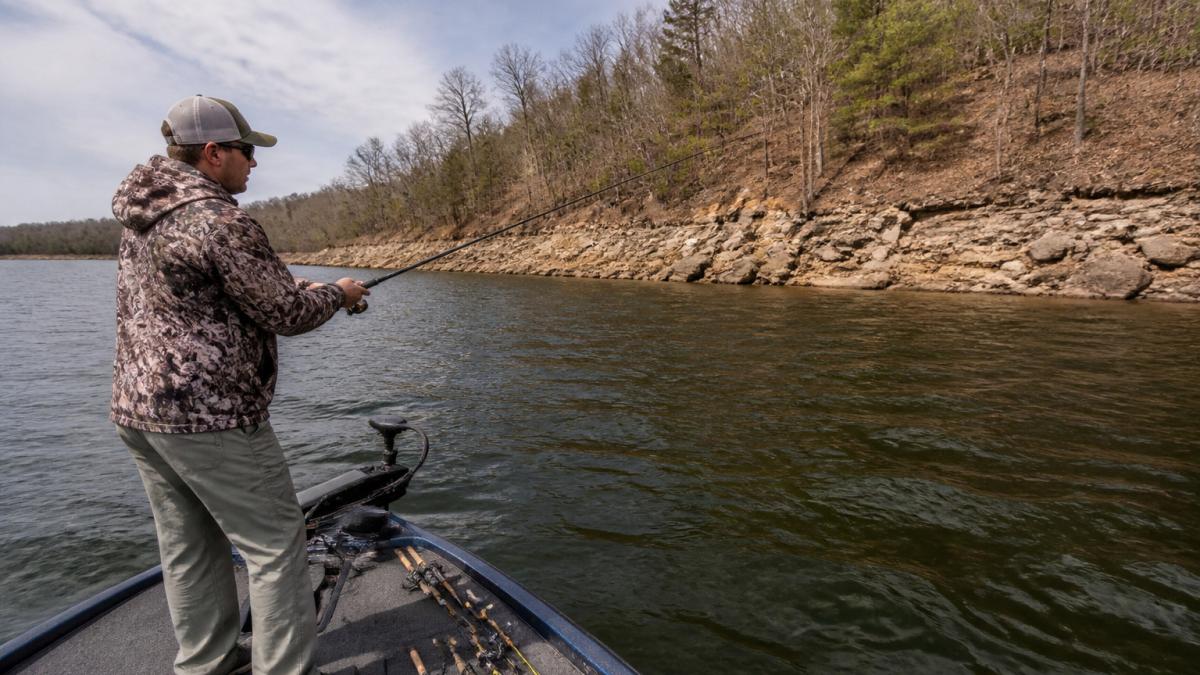
Mid-strolling targets bass that are suspended in the middle of the water column, rather than near the surface or on the bottom. The goal is to keep the bait at the same depth as the fish for as long as possible.
Nasty Lure Company Respect Series →
Depth is the first variable. Match your bait's running depth to the depth where the fish are holding, measured from your sonar. Many anglers make the mistake of running a bait too shallow or too deep and then wondering why fish follow without striking.
Cadence is the second variable. A steady retrieve with short pauses often works when bass are moderately active. Longer pauses suit fish that seem reluctant, giving them time to inspect the bait. Vary the pattern until you see a response, then repeat what works.
Cover is the third. Ledges, submerged brush, and points give suspended fish a reference point and an ambush position. Run your bait along the edge of cover where it is likely to draw strikes, and keep it in the zone above or beside the structure.
Working these three factors together is what separates productive mid-strolling from aimless casting. A common mistake is to fix on one retrieve speed and ignore how the fish respond. Adjust depth, cadence, and cover position based on what the screen and the strikes tell you.
Best Lures for Mid-Strolling With Forward Facing Sonar
Lure choice affects how well a bait holds depth, how visible it is on FFS, and how it reacts to the retrieve. For mid-strolling, you want a bait that runs at a predictable depth, returns a clear signal on the sonar, and holds up under repeated casting.
Hard baits designed for suspended fish are a strong choice. The Nasty Lure Company Respect Series is a flat-sided crankbait built for long casts and a tight wobble. On a steady retrieve it runs in the 10 to 12 foot range, and its gradual slow sink lets you pause and count the bait down deeper. Its internal tungsten gives a strong return on forward facing sonar. It sells for $19.99 at Nasty Lure Company Respect Series.
The Nasty Lure Company ALL IN is a full-depth squarebill. Its gradual slow sink lets you fish it through the water column, and the internal tungsten supports casting and a highly visible return on FFS. It sells for $19.99.
For a hybrid profile, the Nasty Lure Company 360 combines a jerkbait-style body with crankbait depth. Its rotating hook hangers help reduce thrown hooks during jumps and head shakes, which matters when fish strike hard on a pause. It suspends in the 10 to 12 foot range and sells for $27.99.
Soft plastics also have a place in mid-strolling. The RM PZ Worm is a premium soft plastic. It sells for $19.99 and is available in the listed sizes and colors, with limited inventory shown for each variant. Browse the RM PZ Worm for sizes and colors.
The RM Range Worm is another soft plastic option at $17.99. Browse the RM Range Worm.
Mid-Strolling Rod and Reel Setup, Line and Jig Heads
Trade-offs to decide before you cast. Heavier gear pulls fish out of cover but dulls bait action; lighter gear presents better but loses fish in heavy cover. Fast reels favor cadence work; slow reels favor controlled slow retrieves. Braid favors sensitivity; fluorocarbon favors stealth. Pick the balance that fits the water in front of you, and change one component at a time when you are dialing in a pattern so you can tell what made the difference.
The gear you pick shapes how the bait runs and how much fish you pull out of cover, so weigh these trade-offs before you cast.
| Choice | Favors | Trade-off |
|---|---|---|
| Heavier gear | Pulling fish out of cover | Dulls bait action |
| Lighter gear | Better presentation | Loses fish in heavy cover |
| Fast reel | Cadence work | Less control on slow retrieves |
| Slow reel | Controlled slow retrieves | Poorer cadence work |
| Braid | Sensitivity | Less stealth |
| Fluorocarbon | Stealth | Less sensitivity |
A Repeatable Sonar-to-Cast Workflow on the Water
First, scan with FFS at slow speed to locate a school. Mark the position and note the depth band where the fish hold. Second, decide your approach line, planning to pass the bait through the zone from the side rather than directly over the fish. Third, set your bait's running depth to match the school by choosing the right lure and retrieve.
Fourth, make your cast beyond the fish and begin the retrieve so the bait enters the zone before it reaches the school. Fifth, use your sonar to watch the bait's position relative to the fish, adjusting cadence and depth as needed. Sixth, if you get a strike or a follow, note the conditions and repeat the sequence.
Troubleshooting Missed Bites and Unproductive Follows
Consider the boat's noise and speed as well. Heavy motor noise and fast passes can push suspended fish out of position. Slowing down and approaching quietly often restores the bite.
Adjusting Your Strolling for Season, Weather and Water Clarity
The Nasty Lure Company 360 features suspending action and is listed with a Cold Water feature.
The Respect Series has a flat-sided tight wobble, described as offering subtle flash and controlled action for pressured fish and clear water.
Frequently Asked Questions
What is the strolling technique for forward-facing sonar?
Strolling is a slow, controlled presentation where the boat moves forward while the angler keeps a crankbait or swimbait working at a set depth in front of suspended fish. Forward facing sonar shows fish ahead of the boat, so the angler can position the bait in their path before casting. Mid-strolling keeps the bait in the middle of the water column, while hover strolling holds the boat more stationary. Keep the retrieve steady, count the bait down to the depth you see on screen, and maintain contact with cover.
How do you mid-stroll for bass with forward-facing sonar?
Start by scanning ahead of the boat on the sonar and marking suspended fish or bait balls. Cast beyond the targets and retrieve horizontally, adjusting the bait's depth so it passes through the fish's zone. Use a steady cadence and pause when you see a fish rise. Keep your boat moving at a speed that lets the bait stay in front of the marks, and cast again when the fish fall behind the bait.
What is the difference between mid-strolling and hover-strolling?
Mid-strolling moves the boat and the bait forward together, covering water while keeping the lure in the middle of the water column. Hover strolling keeps the boat nearly stationary over a school, letting the angler work a bait in a tight area. Mid-strolling suits moving fish and open water, while hover strolling suits fish holding tightly on structure.
What lures work best for strolling with forward-facing sonar?
The Nasty Lure Company Respect Series is a flat-sided crankbait with a 10-12-foot standard retrieve depth and a tungsten-enhanced forward-facing sonar return; it sells for $19.99. The Nasty Lure Company ALL IN is a slow-sinking squarebill that can be counted down to 20 feet or deeper; it sells for $19.99. The Nasty 360 has suspending action, a 10-12-foot diving depth, and 360-degree rotating hook hangers; it sells for $27.99. The RM PZ Worm sells for $19.99, and the RM Range Worm sells for $17.99.
Can you mid-stroll without forward-facing sonar?
Yes. Strolling can be done with standard 2D sonar or down-imaging, though you lose the ability to see fish ahead of the boat. Without forward facing sonar, anglers rely more on mapping structure, watching the sonar screen beneath the boat, and making casts to likely cover. Adjust the retrieve by feel and by tracking the lure's depth, and expect to spend more time locating fish before presenting the bait.
